
Home / Products / HS-2210 Inorganic High-Temperature Adhesive
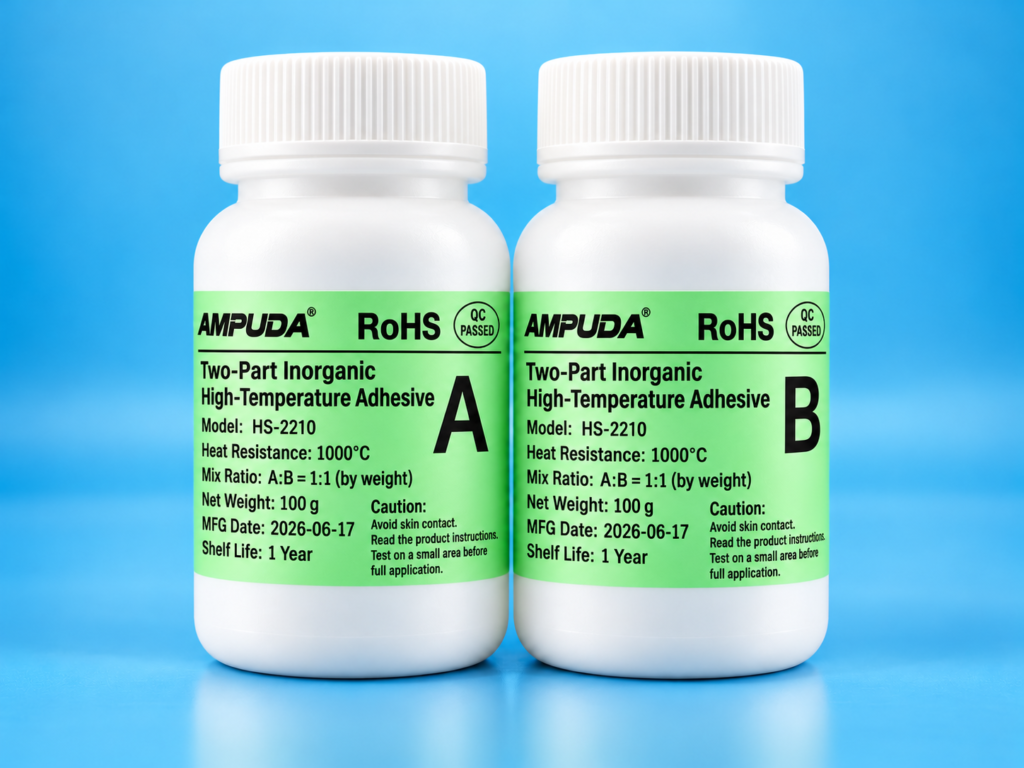
Standard supply packs: 1.6 kg/set or 12 kg/set. Packaging photo shows A and B bottles labelled 100 g each.
HS-2210 Inorganic High-Temperature Adhesive
Model: HS-2210
Two-part inorganic adhesive for bonding, sealing and repair in dry high-temperature environments up to 1000°C.
- Continuous dry-service temperature up to 1000°C
- Two-part inorganic adhesive: liquid A + powder B
- For ceramic, quartz and heat-resistant metal assemblies
Packaging: 1.6 kg/set · 12 kg/set
Overview
HS-2210 is a two-part inorganic adhesive consisting of liquid A and powder B. It cures to a hard grey-white layer for high-temperature bonding, sealing, filling and repair.
Suitable for dry industrial service from −40°C to +1000°C, with a short-term peak of +1200°C. Select the mix ratio and cure schedule for your joint design and application.
Technical specifications
| Continuous temperature | −40°C to +1000°C |
|---|---|
| Short-term peak | +1200°C; validate in your application |
| Mix ratio by weight | A:B = 10:10–20 |
| Working time | Use within 4 hours of mixing |
| Cure for thin joints | 100°C × 2 h; for ordinary bonding / sleeve gaps <0.2 mm |
| Tensile shear strength | ≥1.5 MPa after the stated cure |
| Pressure resistance | ≥5.0 MPa after 100°C × 2-hour cure |
| Storage | ≤28°C, RH≤70%, dry and ventilated |
| Shelf life | 12 months, unopened |
Applications
- Ceramic, quartz and heat-resistant metal bonding
- High-temperature sensor and heating-element encapsulation
- Furnace, oven and kiln component repair
- High-temperature housing, flange and pipe sealing
Application & handling
Clean and dry all bonding surfaces. Mix A:B = 10:10 by weight for bonding, or 10:17–20 for filling and encapsulation. Stir until uniform and use within 4 hours.
For ordinary bonding and sleeve joints with gaps below 0.2 mm: cure at 100°C for 2 hours, then cool with the oven. For thick layers or encapsulation, use staged curing: room temperature 2 h → 40°C for 1.5–2 h → 60–70°C for 1–2 h → 110°C for 4–6 h, then cool with the oven. Avoid sudden intense heating.
Keep cured parts dry and protected from moisture. Not suitable for prolonged water immersion.
Confirm current grade-specific technical and safety data, and validate performance on your actual parts before production.