
Home / Products / HS-2240 High-Temperature Lamp Base Adhesive
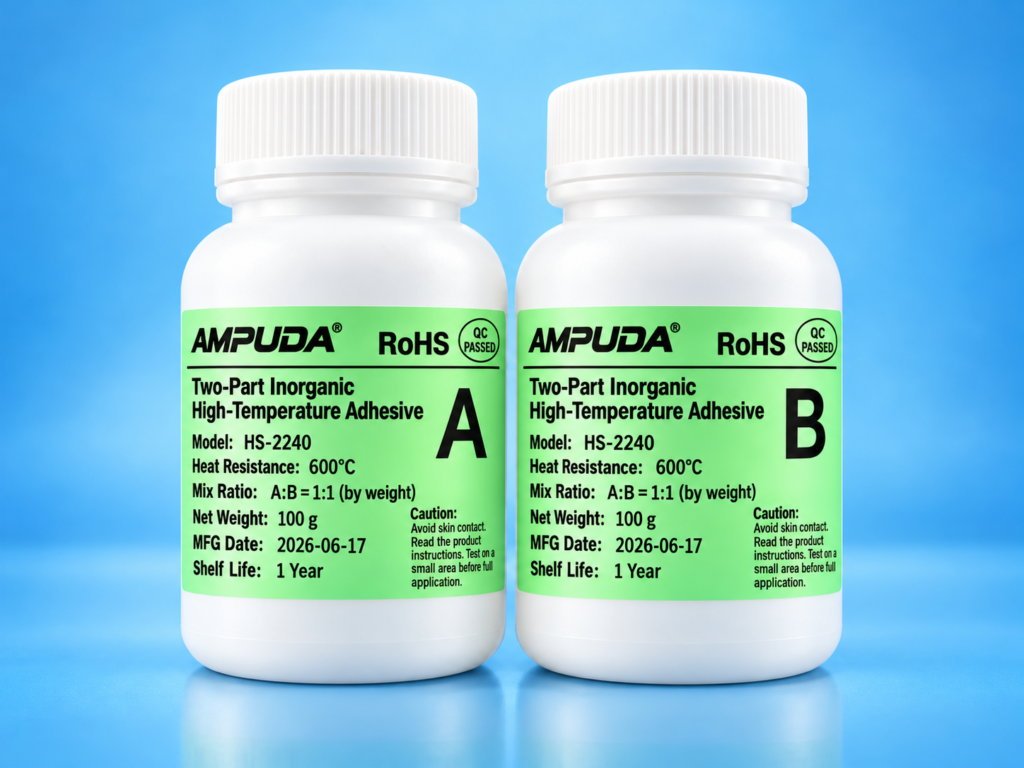
Photo shows A and B bottles labelled 100 g each. Standard supply: 1.6 kg/set; 16 kg/carton. The label shows A:B = 1:1; the product specification permits 1:1–2 by weight.
HS-2240 High-Temperature Lamp Base Adhesive
Model: HS-2240
Two-part adhesive for ceramic lamp bases and quartz glass tubes, with continuous service up to 600°C.
- Continuous service temperature up to 600°C
- For ceramic lamp bases and quartz glass tubes
- Two-part, heat-cured bonding and sealing
Packaging: 1.6 kg/set · 16 kg/carton
Overview
HS-2240 is a two-part, heat-cured adhesive for bonding, fixing and sealing ceramic lamp bases to quartz glass tubes.
Designed for high-temperature lighting assemblies, with a continuous service range of −40°C to +600°C and a short-term peak of +800°C. Validate the joint design and cure process on your actual parts.
Technical specifications
| Continuous temperature | −40°C to +600°C |
|---|---|
| Short-term peak | +800°C; validate in your application |
| Mix ratio by weight | A:B = 1:1–2 (1 part A to 1–2 parts B) |
| Rest time after mixing | 4 hours before application, for air release |
| Use period | Use mixed material within the same day |
| Standard cure | 80–100°C for 2–4 hours; cool with the oven |
| Lower-bubble staged cure | 40°C for 2 hours → 60°C for 2–4 hours; cool with the oven |
| Tensile shear strength | ≥1.5 MPa after 100°C × 2-hour cure |
| Pressure resistance | ≥5.0 MPa after 100°C × 2-hour cure; test method not specified |
| Appearance | A: grey viscous liquid; B: white or red powder; cured: grey-white or red solid |
| Storage | ≤28°C, RH≤70%; cool, dry and ventilated |
| Shelf life | 12 months, sealed and unopened |
Applications
- Ceramic lamp base to quartz glass tube bonding
- High-temperature equipment lighting assemblies
- Quartz heating tube and lamp end sealing
Application & handling
Clean and dry the bonding surfaces. Mix A:B = 1:1–2 by weight until uniform. Let the mixture stand for 4 hours to release air before coating or filling. Use within the same day; discard material that has formed lumps or hardened.
Standard cure: 80–100°C for 2–4 hours, then cool with the oven. For the lower-bubble process: hold at 40°C for 2 hours, then 60°C for 2–4 hours and cool with the oven. The strength values are referenced to 100°C × 2-hour cure; validate other cure schedules on your actual parts. Room-temperature cure is very slow and is not recommended.
Fully cure before further assembly or testing. Keep cured parts protected from prolonged humidity. Wipe excess uncured adhesive with a water-dampened cloth and request the current SDS for safe handling.
Confirm current grade-specific technical and safety data, and validate performance on your actual parts before production.